Common Law Trust Education
Structure the Legacy Before the Legacy Has to Carry Itself.
A Common Law Trust is a governance framework used to organize ownership, responsibility, administration, and beneficiary interests — worth understanding before it's chosen.
Educational information only. Enforceability, tax treatment, privacy, and reporting depend on the governing documents, jurisdiction, facts, and qualified professional review.
The Architecture
Three Trusts, One Framework
Every family, business, and mission has different needs. Three educational pathways make the architecture easier to understand.
Legacy Trust — Protect. Preserve. Provide.
The family layer — beneficiary planning and long-term stewardship.
Management Holdings Trust — Organize. Manage. Multiply.
The business layer — ownership, management, and succession.
Charitable Trust — Impact. Uplift. Legacy.
The purpose layer — philanthropy and mission continuity.
Two Vocabularies
The Difference Is Not a Slogan. It Is the Architecture.
Traditional planning — wills, revocable living trusts, statutory entities — is often appropriate and effective. Common Law Trust education simply asks a different set of questions.
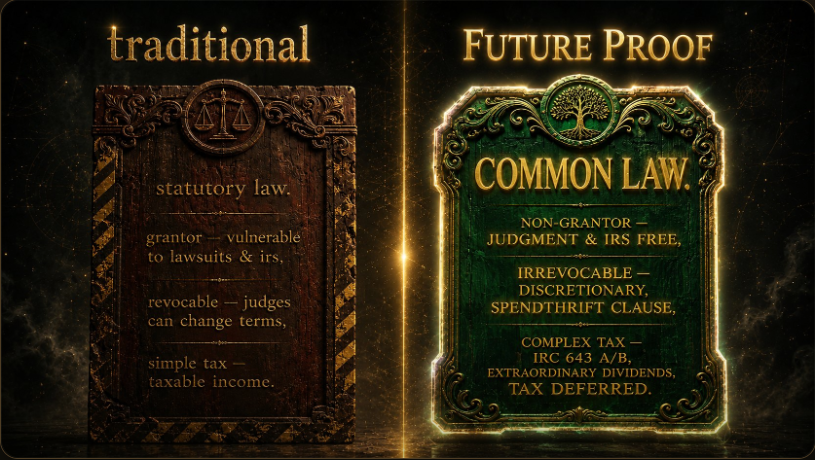
- Is the trust revocable or irrevocable?
- Is it grantor or non-grantor for tax purposes?
- Who controls and administers the property?
- How is the trust funded?
- What reporting and recordkeeping duties remain?
Inside the Trust
Roles, Administration & Recordkeeping
A trust is only as strong as the people running it and the records they keep. Four roles carry it; ongoing administration proves it.
Settlor / Grantor
Creates or funds the trust.
Trustee
Administers it per the governing instrument.
Beneficiary
Receives benefit under the trust terms.
Trust Protector / Advisor
An optional oversight role, clearly defined in the documents.
Administration makes the roles real:
- Proper funding and titling of assets
- Separate records and accurate accounting
- Professional tax preparation and periodic legal review
Before You Commit to a Structure
What a Structured Review Must Answer
A CLT review is a conversation, not a sales pitch. It's designed to surface the practical questions before any document is chosen.